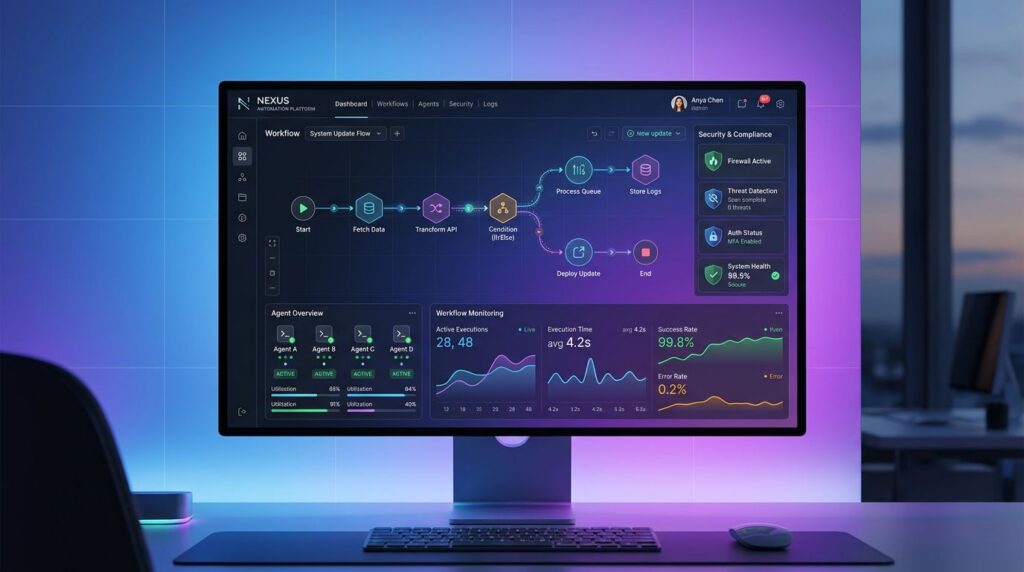
The evolution of n8n toward 2026 marks a turning point in enterprise automation. What began as a visual workflow tool has transformed into a robust technical platform capable of orchestrating intelligent agents, managing complex systems, and providing enterprise-level observability.
## The transformation of n8n: beyond basic workflows
n8n has evolved significantly from its origins as an open-source alternative to Zapier. In 2026, the platform integrates over 1,500 native connectors and positions itself as a technical automation solution that directly competes with enterprise tools like Microsoft Power Automate or Temporal.
The current n8n architecture enables both self-hosted and cloud deployments, offering flexibility for organizations with different security and compliance requirements. This duality is especially relevant for technical teams that need granular control over their automation processes.
### Advanced technical capabilities in 2026
The platform incorporates features that distinguish it from simpler competitors:
– **Distributed execution**: Workflows can run across multiple nodes with automatic load balancing
– **State persistence**: Advanced state management between executions with transaction support
– **Declarative programming**: Workflow definition through code in addition to the visual interface
– **Native container integration**: Full support for Docker and Kubernetes
## Intelligent agents: n8n’s new frontier
One of the most significant additions in n8n 2026 is the intelligent agent system. These agents go beyond traditional rule-based automation, introducing autonomous decision-making capabilities.
### Agent architecture in n8n
Agents in n8n function as autonomous entities that can:
– **Analyze context**: Evaluate input data and determine appropriate actions
– **Execute dynamic workflows**: Create and modify workflows in real-time
– **Interact with APIs**: Make intelligent calls to external services
– **Request human intervention**: Escalate to manual approvals when necessary
“`javascript
// Example agent configuration in n8n
const agentConfig = {
name: “ProcessorAgent”,
model: “gpt-4”,
tools: [
“webhook_caller”,
“database_query”,
“email_sender”
],
memory: {
type: “conversation”,
maxTokens: 4000
},
humanApproval: {
required: true,
threshold: “high_impact”
}
};
“`
This agent capability makes n8n an ideal platform for [[INTERNAL:intelligent-automation]] that requires adaptability and contextual reasoning.
## Observability with OpenTelemetry: enterprise-level monitoring
The native OpenTelemetry integration in n8n 2026 represents a qualitative leap in observability. This implementation enables complete distributed tracing of complex workflows, facilitating the identification of bottlenecks and errors in critical automation systems.
### OpenTelemetry configuration in n8n
Configuration is done through environment variables, enabling seamless integration with existing observability stacks:
“`bash
# Environment variables for OpenTelemetry
OTEL_EXPORTER_OTLP_ENDPOINT=https://jaeger.company.com:14268/api/traces
OTEL_SERVICE_NAME=n8n-production
OTEL_RESOURCE_ATTRIBUTES=service.version=2026.1,environment=production
N8N_METRICS_ENABLED=true
N8N_TRACING_ENABLED=true
“`
### Automatic metrics and traces
n8n automatically generates:
– **Execution traces**: Complete tracking of each workflow from start to finish
– **Performance metrics**: Latency, throughput, and error rates per node
– **Structured logs**: Contextual information in JSON format for advanced analysis
– **Proactive alerts**: Notifications based on configurable thresholds
This observability capability is fundamental for [[INTERNAL:system-monitoring]] in production environments where automation handles critical processes.
## Advanced security: signed webhooks and access control
Security in n8n 2026 includes robust implementations that meet strict enterprise requirements. Signed webhooks represent a significant improvement in data integrity verification.
### Signed webhook implementation
Signed webhooks use HMAC-SHA256 to ensure authenticity:
“`javascript
// Signed webhook validation in n8n
const crypto = require(‘crypto’);
function validateWebhook(payload, signature, secret) {
const expectedSignature = crypto
.createHmac(‘sha256’, secret)
.update(payload)
.digest(‘hex’);
return crypto.timingSafeEqual(
Buffer.from(signature, ‘hex’),
Buffer.from(expectedSignature, ‘hex’)
);
}
“`
### Granular access control
The permission system in n8n 2026 includes:
– **RBAC (Role-Based Access Control)**: Predefined roles with specific permissions
– **Execution policies**: Control over which users can execute specific workflows
– **Complete auditing**: Detailed logging of all actions and changes
– **SSO integration**: Support for SAML, OAuth 2.0, and OpenID Connect
## Advanced error handling and recovery
The robustness of n8n 2026 is evident in its error handling system, designed for production environments where continuity is critical.
### Automatic recovery strategies
n8n implements multiple recovery strategies:
– **Exponential retries**: Intelligent backoff for temporarily unavailable services
– **Circuit breakers**: Automatic protection against degraded services
– **Configurable fallbacks**: Alternative routes when primary integrations fail
– **Transaction compensation**: Automatic rollback in transactional workflows
“`yaml
# Error policy configuration
errorHandling:
retries:
maxAttempts: 3
backoffMultiplier: 2
initialDelay: 1000
circuitBreaker:
failureThreshold: 5
recoveryTimeout: 30000
fallback:
enabled: true
workflow: “error-notification-workflow”
“`
## Human approvals: balancing automation and intervention
One of the most sophisticated aspects of n8n 2026 is its human approval system, which allows maintaining control over critical processes without sacrificing efficiency.
### Configurable approval flows
The system allows defining specific criteria for requesting human intervention:
– **Monetary thresholds**: Approval required for transactions above defined limits
– **Risk analysis**: Automatic evaluation of potential impact
– **Time-based escalation**: Progressive notifications if there’s no response
– **Parallel approvals**: Multiple approvers for critical decisions
This functionality is especially valuable in [[INTERNAL:business-processes]] where complete automation is not desirable or possible.
## Deployment: self-hosted vs cloud in 2026
The decision between self-hosted and cloud deployment in n8n 2026 depends on specific organizational factors.
### Self-hosted deployment advantages
– **Complete data control**: Sensitive information remains on proprietary infrastructure
– **Full customization**: Code-level modifications when necessary
– **Internal system integration**: Direct access to databases and internal services
– **Regulatory compliance**: Meeting specific industry requirements
### Bootstrap with environment variables
n8n 2026 facilitates deployment through declarative configuration:
“`bash
# Complete configuration via environment variables
N8N_HOST=0.0.0.0
N8N_PORT=5678
N8N_PROTOCOL=https
DB_TYPE=postgresdb
DB_POSTGRESDB_HOST=postgres.internal
N8N_ENCRYPTION_KEY=your-encryption-key
N8N_USER_MANAGEMENT_DISABLED=false
N8N_SECURE_COOKIE=true
WEBHOOK_URL=https://n8n.company.com/
“`
### Cloud version benefits
– **Automatic scalability**: Resources that adjust according to demand
– **Managed maintenance**: Automatic updates and patches
– **Guaranteed availability**: 99.9% uptime SLA
– **Technical support**: Direct access to n8n’s development team
The choice between these options should consider factors like [[INTERNAL:enterprise-infrastructure]] and specific compliance requirements.
## Advanced technical use cases
n8n 2026 adapts to complex technical scenarios that go beyond basic automation:
### Microservice orchestration
– **Deployment coordination**: Automation of complex CI/CD pipelines
– **Configuration management**: Settings synchronization between services
– **Proactive monitoring**: Automatic response to performance metrics
### Real-time data processing
– **Intelligent ETL**: Data transformation with adaptive logic
– **Multi-system synchronization**: Consistency maintenance across platforms
– **Event analysis**: Complex pattern processing of data streams
## Conclusion: n8n as an enterprise automation platform
n8n 2026 represents the natural evolution of automation toward a complete technical platform. The combination of intelligent agents, advanced observability, robust security, and deployment flexibility positions n8n as a viable solution for organizations seeking sophisticated automation without sacrificing control.
The ability to handle both simple visual workflows and complex technical orchestration makes n8n a versatile tool that can grow with organizational needs. Its focus on observability and security makes it a solid choice for critical production environments.
Need to implement advanced automation with n8n in your organization? Our specialized team can help you design and implement custom solutions that leverage all the capabilities of this platform. [Contact us](/contact/) for a personalized technical consultation or explore our [automation services](/services/) to learn how we can optimize your business processes.