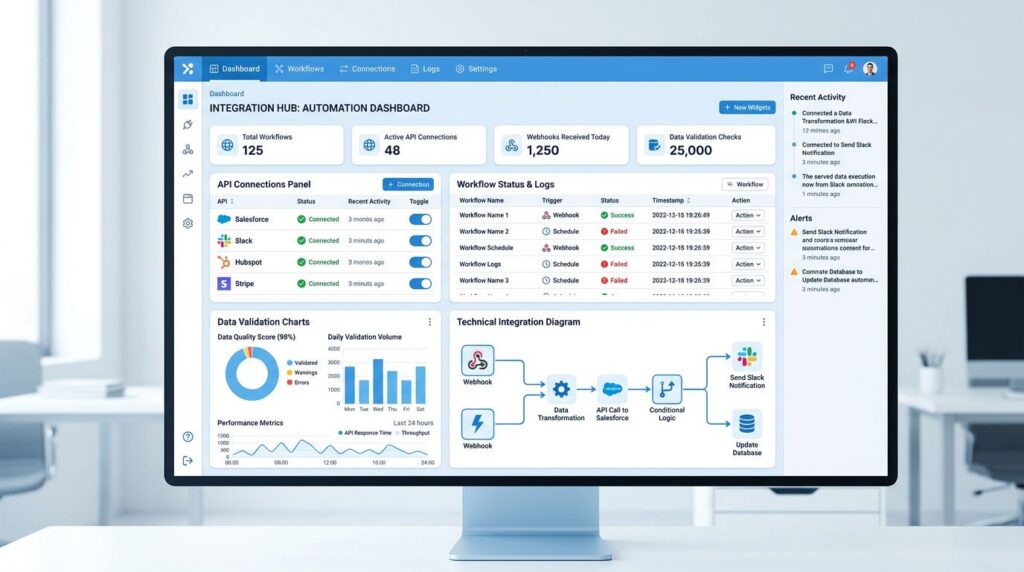
Modern automations require more than simple connections between services. In 2024, demand leans toward robust workflows that don’t break when faced with unexpected changes in external APIs. n8n emerges as a powerful solution for creating maintainable technical automations, especially when you need to validate API contracts and handle webhooks professionally.
This tutorial will guide you through implementing advanced technical automations that include contract validation, robust error handling, and secure webhook configuration.
## Fundamentals of Robust Automations in n8n
The difference between a basic automation and a robust one lies in anticipating failures. APIs change, external services can return unexpected responses, and webhooks can receive malformed payloads.
### Maintainable Workflow Architecture
A maintainable workflow in n8n should include:
– **Input validation**: Verify that received data meets the expected format
– **Error handling**: Alternative routes when something fails
– **Structured logging**: Complete traceability of operations
– **Smart retries**: Automatic recovery from temporary failures
“`javascript
// Example validation in Code node
const validateApiResponse = (response) => {
const requiredFields = [‘id’, ‘status’, ‘data’];
for (const field of requiredFields) {
if (!response.hasOwnProperty(field)) {
throw new Error(`Required field ‘${field}’ not found`);
}
}
return response;
};
“`
## Implementing Secure Webhooks
Webhooks are the most vulnerable entry point in any automation. Incorrect configuration can expose your system to attacks or cause unexpected failures.
### Basic Webhook Configuration
1. **Create the Webhook node** in n8n
2. **Configure authentication** via headers or tokens
3. **Set appropriate timeouts**
4. **Validate the payload** before processing
### Payload Validation
Implement immediate validation after the webhook:
“`javascript
// Payload validation in Code node
const payload = $input.first().json;
// Validation schema
const expectedSchema = {
event: ‘string’,
timestamp: ‘number’,
data: ‘object’
};
// Validate structure
for (const [key, type] of Object.entries(expectedSchema)) {
if (typeof payload[key] !== type) {
return [{
json: {
error: `Field ‘${key}’ must be of type ‘${type}’`,
received: typeof payload[key]
}
}];
}
}
return [{ json: payload }];
“`
### Webhook Authentication
For secure webhooks, implement signature verification:
“`javascript
// HMAC signature verification
const crypto = require(‘crypto’);
const receivedSignature = $input.first().headers[‘x-signature’];
const payload = JSON.stringify($input.first().json);
const secret = ‘your-secret-key’;
const expectedSignature = crypto
.createHmac(‘sha256’, secret)
.update(payload)
.digest(‘hex’);
if (receivedSignature !== expectedSignature) {
throw new Error(‘Invalid signature’);
}
“`
## API Contract Validation
Contract validation is crucial for detecting changes in external APIs before they break your workflows. [[INTERNAL:integraciones-api]] This practice allows you to maintain stable automations long-term.
### Contract Definition
A contract defines the expected structure of API responses:
“`javascript
// Example API contract
const apiContract = {
user: {
id: ‘number’,
name: ‘string’,
email: ‘string’,
profile: {
avatar: ‘string’,
role: ‘string’
}
},
metadata: {
version: ‘string’,
timestamp: ‘number’
}
};
“`
### Validation Implementation
Create a reusable validation node:
“`javascript
function validateContract(response, contract, path = ”) {
for (const [key, expectedType] of Object.entries(contract)) {
const currentPath = path ? `${path}.${key}` : key;
if (!response.hasOwnProperty(key)) {
throw new Error(`Missing field: ${currentPath}`);
}
const value = response[key];
if (typeof expectedType === ‘object’) {
validateContract(value, expectedType, currentPath);
} else {
if (typeof value !== expectedType) {
throw new Error(
`Incorrect type at ${currentPath}: expected ${expectedType}, received ${typeof value}`
);
}
}
}
}
// Usage in workflow
try {
const apiResponse = $input.first().json;
validateContract(apiResponse, apiContract);
return [{ json: apiResponse }];
} catch (error) {
// Send to error route
return [null, { json: { error: error.message, response: apiResponse } }];
}
“`
## Advanced Error Handling
A robust system must anticipate and handle errors gracefully. [[INTERNAL:manejo-errores]] This includes automatic retries, fallback routes, and detailed logging.
### Retry Strategy
Implement retries with exponential backoff:
“`javascript
const maxRetries = 3;
const baseDelay = 1000; // 1 second
let attempt = $input.first().json.attempt || 0;
if (attempt < maxRetries) {
const delay = baseDelay * Math.pow(2, attempt);
return [{
json: {
...payload,
attempt: attempt + 1,
delay: delay
}
}];
} else {
// Maximum retries reached
throw new Error('Maximum retries exceeded');
}
```
### Structured Logging
Maintain complete traceability of operations:
```javascript
const logEvent = {
timestamp: new Date().toISOString(),
workflowId: $workflow.id,
executionId: $execution.id,
nodeId: $node.id,
event: 'api_call',
details: {
url: apiUrl,
method: 'POST',
statusCode: response.statusCode,
duration: responseTime
}
};
console.log(JSON.stringify(logEvent));
```
## Integration with Complex APIs
Modern APIs require sophisticated handling of authentication, pagination, and rate limiting. [[INTERNAL:apis-rest]] n8n provides tools to handle these scenarios.
### OAuth2 Authentication
Configure OAuth2 flows for APIs that require it:
1. **Register your application** with the API provider
2. **Configure credentials** in n8n
3. **Implement automatic token refresh**
4. **Handle token expiration**
### Automatic Pagination
For APIs with paginated responses:
```javascript
const getAllPages = async (baseUrl, headers) => {
let allData = [];
let nextUrl = baseUrl;
while (nextUrl) {
const response = await $http.request({
method: ‘GET’,
url: nextUrl,
headers: headers
});
allData = allData.concat(response.data.items);
nextUrl = response.data.next_page_url;
}
return allData;
};
“`
## Monitoring and Alerts
Implement proactive monitoring to detect issues before they affect end users. [[INTERNAL:monitoreo-sistemas]] This includes performance metrics, failure alerts, and status dashboards.
### Key Metrics
– **API response time**
– **Webhook success rate**
– **Error frequency** by type
– **System resource usage**
### Alert Configuration
“`javascript
// Alert for high error rate
const errorRate = failedRequests / totalRequests;
const threshold = 0.05; // 5%
if (errorRate > threshold) {
// Send alert
await $http.request({
method: ‘POST’,
url: ‘https://hooks.slack.com/services/…’,
json: {
text: `🚨 High error rate detected: ${(errorRate * 100).toFixed(2)}%`
}
});
}
“`
## Conclusion
Robust technical automations in n8n require more than connecting basic services. Implementing contract validation, sophisticated error handling, and secure webhooks is fundamental for creating maintainable long-term systems.
Investment in these practices translates to less maintenance time, greater system reliability, and better end-user experience. In an environment where APIs constantly change, these techniques are the difference between fragile automations and robust systems.
Need to implement advanced technical automations in your organization? Our specialized team can help you design and develop robust workflows that scale with your business. [Contact us](/contact/) for personalized consulting or explore our [automation services](/services/) to learn more about our solutions.